
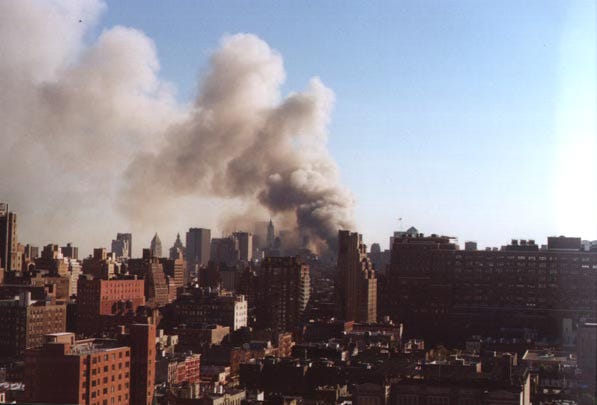
Those of us who were here in New York City on September 11, 2001, will never forget what we saw and experienced. For me, it feels like it happened yesterday, and the events of that day are seared into my memory. For many years I didn’t discuss my experience because I didn’t want to relive the trauma. But many years have gone by, and there is something cathartic in telling one’s story, so here is mine…
The weather was beautiful that day. Clear blue sky, maybe a tad cooler out. Summer was coming to a close and fall was just around the corner. I was 19 years old at the time. Sleeping in my bed on the Upper West Side, I was suddenly jolted awake when my father, who was visiting me from out of state, burst into my room. “You have got to see this!” he yelled.
I got up and went to the living room. The first plane had hit the North Tower of the World Trade Center. The images were plastered across the TV screen. A gaping, smoking hole in the middle of the building. We both stood there dumbstruck with disbelief.
I looked at my dad. “I have to see this for myself. Get your camera. We’re going downtown,” I said.
We jumped on the subway and made it as far as Times Square before all service came to a halt. We started walking to the West Side Highway and noticed people gathering around car radios or TVs inside restaurants, cafes, and stores to see what was unfolding at the World Trade Center. But we didn’t stop to listen or watch.
Upon reaching the West Side Highway, only then did the enormity of what occurred dawn on us. The towers had just collapsed and all of downtown Manhattan was blanketed in a massive, rolling cloud of debris, spreading outward into city blocks and onto the Hudson River. The cloud engulfed and swallowed entire skyscrapers and sections of the island like some great monster. The sight was beyond surreal.
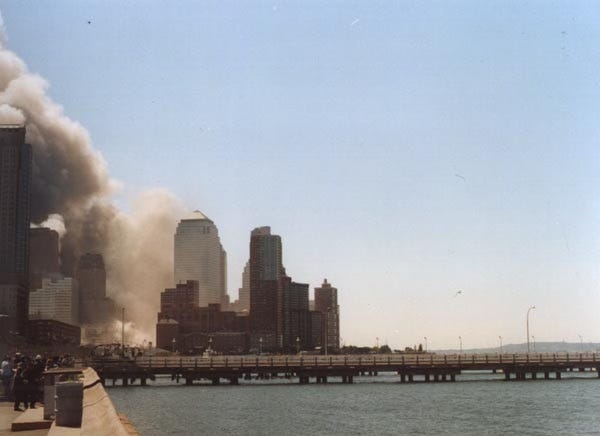
For some confusing minutes we believed—or perhaps we wanted to believe—the towers were still there, still standing behind the smoke. Only when we stopped to ask someone did the reality finally hit us: two planes. Fifteen minutes apart. Attack. Towers collapsed. Tens of thousands feared dead. Impossible, how could this happen? I remember thinking.
We continued down the highway while thousands of people streamed up on foot from downtown. Some were covered head to toe in what looked like a fine white powder. Others—the elderly, the unfit, those with injuries—were being helped along by co-workers and strangers. Everyone had the same look on their face—utter shock, trauma, horror, disbelief. Emergency police, fire, and medical vehicles of all types raced up and down the left side of the highway.
We stopped near the Jacob Javits Center. People were clustered around a few cars, listening to the radio. The Pentagon in Washington DC had just been struck by a plane and it was on fire, the radio blared. We were under attack, but we didn’tknow who yet. My dad and I looked at each other with astonishment. The Pentagon? The very seat of American military power now in flames? My mind flashed to HG Wells’ famous novel, The War of the Worlds, where humanity experiences a sudden, surprise alien invasion of Earth. Was this really happening? Some massive, surprise attack on American soil?
We realized that we had front-row seats to an event even bigger than Pearl Harbor. History was unfolding right before our eyes.
We continued to walk south.
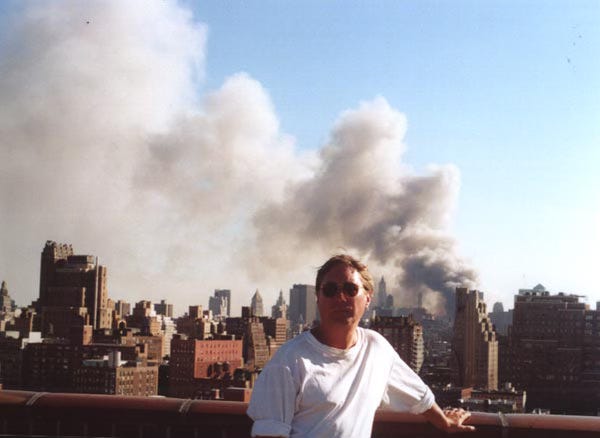
At one point a rumor spread through the crowd that the gas lines beneath the highway had ignited and were going to blow up any second. This caused immediate panic and a stampede. Everyone ran. I grabbed my father, and we raced to the water’s edge, preparing to scale a fence and dive into the Hudson River should any explosions occur. Thankfully, nothing happened, and the crowd eventually calmed down.
We made it as far as Chambers Street before we ran into a police blockade. They wouldn’t let anyone forward except emergency personnel.
We passed a small park where a triage area for injured people, some of them firemen, had been set up. EMTs and medical personnel raced around, tending to the wounded. Firemen, some having just emerged from the debris cloud caked in dust, had bottled water poured on their faces and in their eyes. Some were struggling to breathe. Others sat down on the curb, completely in shock, looking like a bomb had just blown them up. Others still held each other and cried.
A crowd of construction workers, motorcycle bikers, and other volunteers had assembled, shovels and pickaxes in hand. Faces covered with dust masks, shirts, cloth, whatever they could find. Someone with a megaphone was giving them orders. They began to march southward, into the debris cloud, to rescue the trapped and the injured. Sheer determination on their faces. That is what courage is I remember thinking.
We ducked into a bar—the Ear Inn, on Spring and Greenwich streets—and joined others in watching the news on the TV. Grim faces everywhere. We began our long walk back uptown.
We passed by Saint Vincent’s Hospital. A line of people stretched down the block, waiting to donate blood. A crowd of nurses and doctors milled around out front, waiting to receive the wounded. They waited and waited, and so did we, but nobody came. There was no wounded. Everyone in the collapse was dead.
That night, we could see the fires burning downtown, illuminating the smoke cloud that still hung over the tip of the island. A rancid smell wafted uptown on the wind, a smell that lingered for weeks. It was the smell of burning concrete, steel, and bodies.
A day no one who was there will ever forget. https://youtu.be/B1OQjhQ-e38?si=is_leaPYYCEdjtiE